
Excursionsin Paris and France
Paris with a private guide, Versailles, Fontainebleau and Chartres, Champagne, Normandy and the Loire châteaux — by car with a driver-guide, at your own pace.
Excursions in Paris and across France. Classic tours, walks around Paris and sightseeing. Trips by car with a driver-guide across France. Gastronomic excursions with tastings.
Paris Excursions with a Private Guide
We offer private guided excursions in Paris!
We guarantee that during the excursion:
- There will be no affiliated shops along the way where you'd be charged 3 times the going rate for souvenirs and the like.
- Our guide will speak fluent English, French or Russian and know everything about the places you visit;
- The group will consist of you and no one else.
- You will be completely safe.
Guided sightseeing tour of Paris (from 3 hours)
A sightseeing tour of Paris gives you a general picture of the city, its layout, its history and its main landmarks. It can be more or less detailed depending on the client's wishes. It lasts anywhere from 3 to 8 hours.
On a classic three-hour tour of the city by car you can see the Church of the Madeleine, which resembles an ancient temple; the Place de la Concorde, one of the most beautiful and largest squares in the city, with its famous Egyptian obelisk and fountains; the elegant Champs-Élysées; and the Arc de Triomphe, the symbol of Napoleon's victory at Austerlitz. The route then passes through the Place du Trocadéro, with its superb view of the Eiffel Tower and the Champ de Mars, followed by Les Invalides, where the remains of the great Napoleon lie, the Musée Rodin, and the Pont Alexandre III, rightly regarded as a symbol of Franco-Russian friendship. Next come the Musée d'Orsay and then the Île de la Cité, the cradle of Paris, where a stop is planned to see Notre-Dame Cathedral. The Place des Vosges, with its preserved 16th- and 17th-century residences; the world-famous Sorbonne University and the adjoining Latin Quarter; the majestic Panthéon, where France's heroes and most famous figures are buried; the Luxembourg Gardens, which have seen so many great figures, from Marie de' Medici to Napoleon. The Saint-Germain quarter, where Dumas's heroes lived; the Louvre, a former royal residence and now one of the most famous museums in the world; the Place Vendôme with its austere and elegant 18th-century mansions and the boutiques of renowned jewellers; and the lavish, majestic Opéra Garnier, the world's largest opera house. If the tour is extended, you can see some of the districts, monuments and churches of Paris in more detail, stroll through one of its picturesque parks, view the interior of the Opéra or look into the courtyard of the Palais-Royal. After lunch the tour can continue up to Montmartre, crowned by the snow-white Sacré-Cœur, and on to the Place de la Bastille, Châtelet and Place de la République, the Bois de Boulogne or La Défense, the modern business district of Paris.
For those who have already been to Paris several times, we offer a range of themed excursions or walking tours of the city's historic districts.
Our guides can show you Paris from a different angle, in more detail and at a leisurely pace, with stops and visits to cathedrals, parks, small streets and corners of the city that cannot be visited on a traditional city tour. Such an excursion might, for example, focus on the Île Saint-Louis, where there is almost no traffic, or on the Tuileries Garden and the Musée de l'Orangerie, with its remarkable collection of paintings by French artists of the second half of the 19th century, including Claude Monet's famous Water Lilies series. In fine weather, this excursion can be combined with a trip to Giverny, with the delightful gardens and the house where the artist lived.
A few examples of themed excursions:
- Theatrical Paris
- Gastronomic Paris
- Churches and places of worship in Paris
- Cinematic Paris
- Paris, city of celebrities
- Paris, capital of fashion and luxury
- The gardens and parks of Paris
- Antique Paris
- The Da Vinci Code
Guided tour of the Louvre (Le Louvre)
Before setting out on the Third Crusade, King Philip Augustus (late 12th century) ordered a wall to be built around Paris. Where this city wall met the Seine, a thirty-two-metre tower surrounded by a wall and a moat was built on the Right Bank; this fortress was the original Louvre. The name of the place existed long before then and apparently meant "fortification" in the Frankish language (lower). From the mid-14th century, the Louvre was a royal residence. The Louvre has seen many figures who shaped the history not only of France but of the whole world. Years passed and kings changed; some preferred to live in the Louvre, others elsewhere. But each of them added something of their own to the palace. On 10 August 1793 it became a museum. The Louvre's collection is divided into seven departments, covering works created from the dawn of the great ancient civilisations up to the first half of the 19th century. Among the most valuable is the collection of the "Egyptian department", one of the richest in the world, founded in 1826 by the famous Egyptologist Jean-François Champollion himself. And can one visit the Louvre without seeing the world-famous Venus de Milo, the ancient Greek statue of the goddess Nike, Leonardo da Vinci's incomparable Mona Lisa, and the works of Raphael, Titian, Bosch, Pieter Bruegel the Elder, Rubens, Michelangelo, Cellini...
Duration of the excursion: 3 hours
Guided tour of the Orangerie (Orangerie)
A museum that brings together the finest works of the French Impressionists. Any museum in the world would envy such a collection of acknowledged masterpieces. Daylight once again illuminates Claude Monet's famous Water Lilies, as well as the canvases of his fellow artists. Reopened to the public after a painstaking six-year restoration, the Musée de l'Orangerie has paid tribute to the Impressionists' love of light, gaining a vast glass roof and a resemblance to the greenhouse it originally was. During the renovation, the low grey ceiling that for almost four decades had divided the museum into two floors was removed, and a huge glass skylight was installed above the great Impressionist masterpieces. Here you can once again see the finest works of Claude Monet, Henri Rousseau, Modigliani, Picasso and Matisse, along with other works from the Walter Guillaume collection.
Duration of the excursion: 2.5 hours
Guided tour of Notre-Dame Cathedral (Notre Dame de Paris)
It would be better to call this cathedral the Paris Cathedral of Our Lady, since Chartres, Orléans and Rouen also have a Cathedral of Our Lady – every city in France has its own Notre-Dame. But only the one in Paris was named by Louis XIII the parish church of France, to express the profound reverence the cathedral has enjoyed throughout the ages. So many events took place within its walls that became true milestones of French history: the first Estates General, convened in 1302 by Philip IV the Fair; the rehabilitation in 1456 of the French national heroine Joan of Arc, burned by the English on charges of witchcraft in 1431; the solemn mass in 1572 for the marriage of Marguerite de Valois, the future Queen Margot, to Henry, King of Navarre, the future King Henry IV of France; and the coronation of Napoleon in 1804. It is no accident that Victor Hugo made the cathedral the hero of his novel of the same name – not Quasimodo, not Esmeralda, but Notre-Dame itself. We invite you to open this book and leaf through the pages of its centuries-old history.
Duration of the excursion: 3 hours
Guided tour of Montmartre Hill (Monmartre)
Montmartre Hill (Monmartre) lies in the north of the city and is the highest point in Paris. Montmartre was, and remains, one of the most picturesque districts of Paris. It grew up on a limestone hill 130 metres high where, according to legend, Saint Denis, the first bishop of Paris, was beheaded in 272. Throughout the 19th century Montmartre was a magnet for those artists for whom a bohemian life meant, above all, living freely, devoting themselves solely to art and rejecting all the conventions and constraints of the outside world. Every artist, from the most famous to the little known, left a trace of their life and work on Montmartre. Even today the hill is home to people who live and work here, filling its narrow winding streets, old shops and cafés with their art and unhurried way of life.
The viewing terrace offers a breathtaking view, especially in clear, sunny weather. All of Paris, as they say, lies in the palm of your hand. From here you can take in both modern architecture and the old city with its tiny gardens and chimney pots on the rooftops. The steps of the Sacré-Cœur Basilica, which crowns the Montmartre hill, are always crowded. Not only tourists but Parisians too consider Montmartre a favourite place to relax. Seated at the foot of the church, young people listen to street musicians, taking a lively part in these open-air concerts. Sit among them and feel part of the unhurried Parisian way of life. Visit the white-stone beauty of the Sacré-Cœur; during services its organ sounds extraordinarily beautiful. The church is a highly complex architectural structure. Its height almost equals that of Montmartre itself, so the basilica seems to tower over the whole city. The remarkable whiteness of the building is explained by the property of its stone, which turns whiter under the action of rainwater.
Duration of the excursion: 3 hours
Excursion: "The gardens and parks of Paris – Gardens and parks of Paris"
The famous style of the French formal garden took shape in France at the end of the 17th century. You can admire the finest examples of landscape design in the very centre of Paris: the famous Tuileries Garden, designed by the great 17th-century master André Le Nôtre, and the Luxembourg Gardens, created by Italian masters, rightly regarded as one of the most romantic places in Paris and home to an incomparable collection of statues of the queens of France.
The gardens and parks created in the 18th century under the influence of English landscape designers certainly deserve attention too – for example, the charming Parc Monceau. The second half of the 19th century is represented by one of the most exquisite parks, the Buttes-Chaumont, and the charming Parc Montsouris, as well as the famous landscape ensemble of the Bois de Boulogne, home to the Paris racecourse and the Bagatelle rose garden. The 20th century and contemporary landscape art are represented by the Parc André-Citroën and the Parc de Bercy.
Duration of the excursion: 3 hours (by car)
Excursion: "Gastronomic Paris"
(not recommended on Sundays or French public holidays)
We invite you on a journey through the city of great gourmets and chefs, during which we will try to reveal the secrets behind the worldwide fame of the Masters of French Gastronomy and give you the chance to savour their unrivalled masterpieces. Our guide will tell you many fascinating things about the history of French cuisine, its traditions and its contemporary trends. You can visit an old bakery, the finest chocolate and cheese shops, a truffle shop, wine cellars and the most interesting and famous food shops in Paris, and form your own opinion of France's legendary gastronomy.
In France, cooking has been raised to the status of an art. As in any art, there are geniuses and craftsmen, and there are prestigious awards. Chefs put all their talent into creating gastronomic wonders. Their aim is to win over the public and claim the top prize, the most prestigious award of all – a star in the annual Michelin Guide. If you wish, the excursion can end with lunch or dinner at one of the most refined and luxurious Michelin-starred restaurants in Paris. Or it can be complemented by a visit and tasting of the finest French wines and gourmet products at the famous Fauchon shop (at extra cost).
Duration of the excursion: from 3 hours
Excursion: "Antique Paris"
The streets where private antique galleries are located are known as the Drouot quarter, after the main auction house of Paris.
These galleries sell silverware and dinner services, Delft porcelain, carpets, and European paintings and drawings of the 19th and 20th centuries.
Opposite the Louvre, the royal palace and museum, separated from it by the Rue de Rivoli, lies the Louvre des Antiquaires. It is a vast multi-level space with fountains, a bar and seating areas, divided by aisles lined with antique galleries. These expensive, luxurious galleries astonish with the sheer variety of what they offer. No antiques fair in Moscow or St Petersburg brings together as many dealers and as many works of art in one place as the Louvre des Antiquaires.
Each gallery has its own speciality. Lovers of military trophies and admirers of Napoleon Bonaparte can examine 19th-century rifles and sabres, or buy a cigarette case bearing Napoleon's profile or a teaspoon topped with a figurine of the "ruler of minds".
Several galleries specialise in Russian art, including antique Russian jewellery and silver.
From the banks of the Seine deep into the Faubourg Saint-Germain stretches the antiques quarter known collectively as the "Carré Rive Gauche". The galleries occupy the ground floors of the picturesque old residential buildings of this wealthy, bourgeois and at the same time bohemian district of old Paris. Next to the boutiques of Cartier, Sonia Rykiel and other famous designers, the windows of antique dealers sparkle, offering strolling Parisians and visitors Italian Renaissance furniture, Murano glass vases, goblets and chandeliers, Art Deco furniture, antique carved frames, Russian icons, 17th- and 18th-century French engravings and Venetian mirrors.
Duration of the excursion: from 3 hours
Work out the price
Our rates for guided excursions in Paris. Choose an option and a car class — the price updates instantly.
Show the full price list
| Excursion | Duration | Standard (1-3 pax) | Standard (1-7 pax) | E-Class, Audi A4 (1-3 pax) | Viano, V-Class (1-7 pax) | S-Class (1-3 pax) |
|---|---|---|---|---|---|---|
| Paris sightseeing tour | 3 h | 340€ | 405€ | 405€ | 520€ | 810€ |
| Paris sightseeing tour | 4 h | 405€ | 520€ | 520€ | 630€ | 1015€ |
| Versailles | 4 h | 405€ | 520€ | 520€ | 630€ | 1015€ |
| Fontainebleau - Barbizon | 7 h | 835€ | 900€ | 900€ | 1080€ | 1800€ |
| Chartres | 5 h | 495€ | 565€ | 720€ | 720€ | 1170€ |
| Reims - Épernay | 10 h | 990€ | 1125€ | 1125€ | 1440€ | 2340€ |
| Deauville - Honfleur | 10 h | 1015€ | 1150€ | 1150€ | 1465€ | 2365€ |
| Loire Valley châteaux | 12 h | 1125€ | 1305€ | 1305€ | 1645€ | 2725€ |
Private Excursions around Paris
It is man who can make the Way great, and not the Way that can make man great.
We offer private guided excursions in the surroundings of Paris!
We guarantee that during the excursion:
- There will be no affiliated shops along the way where you'd be charged 3 times the going rate for souvenirs and the like.
- Our guide will know everything about the places you visit;
- The group will consist of you and no one else.
- You will be completely safe.
Would you like to make the most of your stay in France and see its finest sights without sacrificing comfort? With our services you can enjoy excursions in complete comfort in business and executive class cars. If required, we will provide a personal guide who will tell you the story of each historic monument in an engaging and knowledgeable way, helping you become better and more fully acquainted with the history and traditions of France and immerse yourself in its culture.
Guided tour of Versailles (Versailles)
Versailles was chosen by King Louis XIII as the site for a modest hunting lodge. The king wished to indulge his favourite passion here – hunting. His son, Louis XIV, was also a keen hunter, but he had far more ambitious plans for the place. Dissatisfied with his other palaces (the Louvre among them), in 1660 he decided to rebuild Versailles as a magnificent palace and park. Everything here astonishes with its splendour and scale, for the king wanted the royal court to reside here. The parks of Versailles extend over 101 hectares. There are many viewpoints, avenues and promenades, and even a Grand Canal of its own – or rather a whole system of canals, nicknamed "Little Venice".
The fountains of Versailles embody the idea of glorifying Louis XIV. The most celebrated painters, architects and sculptors were invited to build the palace.
Duration of the excursion to Versailles: 4 hours without lunch and 6 hours with lunch.
During the excursion you will visit the royal palace and take a walk through the park.
Watch the videoYouTube · opens in a new tabGuided tour of Fontainebleau (Fontainebleau)
From the 13th century the château was a royal residence. Kings Philip the Fair, Francis II and Louis XIII were born here. Emperor Charles V and the crowned heads of Europe stayed here, among them Peter the Great. It was here in 1814 that Napoleon abdicated the throne, and here in 1815 that he was arrested. The château was largely rebuilt under Francis I in the 16th century. Royal apartments and bedchambers that have seen almost every queen and empress, throne rooms and ballrooms, famous galleries, the palace chapel, parks, ponds and fountains…
Duration of the excursion to Fontainebleau: 5 hours. During the excursion you will visit the royal château and park.
Watch the videoYouTube · opens in a new tabGuided tour of Barbizon
Barbizon (Barbizon) is a small town that in the 19th century became a "Mecca" for French landscape painters, who founded the "Barbizon school", a forerunner of Impressionism. Its members included Théodore Rousseau, Millet and Daubigny. Their favourite subjects were ordinary, everyday landscapes in which they sought to convey nature's many moods and the vibration of light and air. Working from nature, the Barbizon painters paid particular attention to capturing the immediate impression and developed a method of tonal painting rich in nuances of light and colour. Through their work they proved the aesthetic value of the national landscape. Trotsky liked to holiday in Barbizon. The restaurants of Barbizon are known for refined French cuisine and a standard of service found in Paris only in the most prestigious establishments.
The excursion to Fontainebleau can be combined with a visit to the town of Barbizon. Duration of the excursion with lunch in Barbizon: 8 hours.
Guided tour of Vaux-le-Vicomte
The Château de Vaux-le-Vicomte (Vaux-le-Vicomte) is a masterpiece of French architecture.
It belonged to the finance minister Nicolas Fouquet. Intoxicated by his rapid and highly successful career, Fouquet decided to dazzle the king and his entourage with an extraordinary reception. The dinner was served on solid gold plate, guests were entertained by waltzing horses (some of which drowned in the moat), and Monsieur Molière presented his first comédie-ballet here. Spectacular fireworks exploded in the sky, and guests strolled through the magnificent garden laid out by the finest garden and park architects, Le Vau and Le Nôtre. But instead of thanking Fouquet for the lavish reception, Louis XIV was enraged that his minister's château was grander than the king's own, and had him thrown into prison. The king then ordered Le Nôtre and Le Vau to build an even more majestic château and park. And so Versailles came into being.
Duration of the excursion, by day or in the evening: 5 hours (in the evening, by candlelight). During the excursion you will visit the château and park.
Watch the videoYouTube · opens in a new tabGuided tour of Compiègne
Compiègne (Compiègne) is a royal town on the river Oise, close to a forest of breathtaking beauty with centuries-old trees. From Merovingian times to Napoleon III, the kings and emperors of France lived here in a château built in the 9th century by Charles the Bald. An abbey soon appeared and a town grew up around it. It was a necropolis of the French kings and a centre of learning and culture. Every French king loved to spend time here.
In 1429 Philip the Good, Duke of Burgundy, eager to gain Picardy, decided to seize Compiègne with the help of English forces. Joan of Arc, who was here at the time, was unable to thwart his plans and in May 1430 was taken prisoner by the Burgundians. During the First World War the château became the headquarters of Pétain's army. And in the forest, 800 metres from the château, the Armistices of 11 November 1918 and 22 June 1940 were signed.
Compiègne is also famous for its ancient forest, which borders the town to the south and west. Its 15 000 hectares of timber forest are crossed by avenues offering beautiful views of the château. This historic reserve was a favourite royal hunting ground.
Guided tour of Pierrefonds
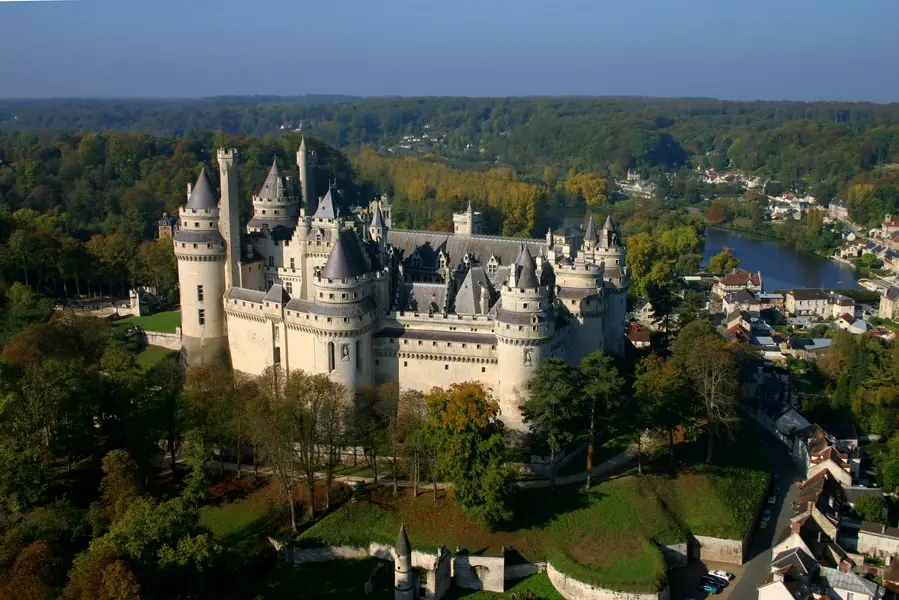
The Château de Pierrefonds (Château de Pierrefonds) is a true medieval fortress, built by Louis of Orléans in the 14th century according to the rules of medieval military architecture. This jewel of the Middle Ages has survived thanks to the architect Viollet-le-Duc. Under Napoleon III, in 1857 and then by 1884, the pentagonal château with its eight towers and dominant keep regained its original appearance. Pierrefonds was a château of an entirely new type: from the outside it was the finest example of the military architecture of its time and remains so to this day. Yet Pierrefonds was not merely a military structure; it housed a splendid residence that included the Hall of Heroines and the Hall of the Knights of the Round Table, each adorned with rich tapestries, reflecting the architect's romantic leanings.
Duration of the excursion to Compiègne and Pierrefonds: 8 hours.
Watch the videoYouTube · opens in a new tabGuided tour of Giverny
On the way from Paris to Normandy lies the town of Giverny (Giverny), made famous by Claude Monet. Here you will find the house of the celebrated Impressionist painter and the garden with the pond where he painted his Water Lilies. From 1883 Claude Monet rented this property from a Norman landowner, 80 kilometres north of Paris. Monet lived here for forty-three years, until his death in 1926.
Having settled in Giverny, Claude Monet bought a plot of land there and, diverting water from the little river Epte, created a water garden with ponds. The garden is laid out in front of the house, and the strict straight lines of its paths stand out in sharp contrast to the colourful carpet of flowerbeds, fragrant all year round and changed several times a year. The garden became Monet's beloved creation, and it is no surprise that its motifs occupy such a large place in the artist's work. For almost his entire life Monet lived in houses with gardens – in Argenteuil, in Vétheuil and in Giverny – and he invariably captured them on canvas.
After a visit to Monet, the German art historian Julius Meier-Graefe remarked: "Monet reveals himself best through the garden he planted around his country house. He created it according to the same principles as his paintings. Every single flower merges into the overall harmony of colours."
Claude Monet's House and Gardens are open to visitors from April to October; closed on Mondays.
Duration of the excursion: 5 hours without lunch and 6 hours with lunch. During the excursion you will visit Claude Monet's house and take a walk through the garden.
Watch the videoYouTube · opens in a new tabGuided tour of Malmaison
In the picturesque Paris suburb of Rueil-Malmaison (Rueil-Malmaison) stands a unique monument of the Napoleonic era. It is a small and very intimate château whose walls heard the voices of Josephine and Bonaparte, and where you can see Napoleon's throne from Fontainebleau, the camp bed on which he died, and the death mask of this great man.
In 1799 Josephine moved into the Château de Malmaison, a gift from her absent husband, who spent his rare free time here between wars and campaigns. Napoleon won battles while Josephine won hearts and held lavish receptions. She was happy here and felt herself to be the true mistress of the house. To the existing 17th-century buildings Josephine added a picturesque veranda and a small theatre. She never stopped remodelling the initially modest château, turning it into a true "Palace of Wonders". Gathering remarkable plants from all corners of the world, she assembled in the park at Malmaison a collection of flowers that had never before existed in Europe. Among them was the Bourbon rose sent to her from the Île Bourbon, which was named "Souvenir de la Malmaison". This exquisite rose remains a beautiful flower to this day, despite being more than a century old. Josephine always wore this rose in her hair whenever she did not have her beloved violet.
Magnificent festivities were held at Malmaison during receptions for crowned heads from all over Europe. Alongside the palaces of Fontainebleau and Compiègne, Napoleon granted Malmaison the status of "Imperial Palace" by special decree.
Duration of the excursion: 4 hours. During the excursion you will visit the château and park.
Watch the videoYouTube · opens in a new tabGuided tour of Auvers-sur-Oise
The small, picturesque town of Auvers-sur-Oise (Auvers-sur-Oise), nestled on the banks of the river Oise, is just 35 km from Paris. In the 19th century many Impressionist painters stayed in this town. It was here that Vincent van Gogh found his last refuge. Vincent loved Auvers-sur-Oise very much. He lived here for only two months, during which he painted more than 70 pictures.
During the excursion you will see the Church of Notre-Dame (Notre-Dame), built in the Romanesque-Gothic style of the 12th–13th centuries, which inspired the artist to create one of his best-known masterpieces, now held in the Musée d'Orsay in Paris.
You can also visit the Auberge Ravoux (Auberge Ravoux), known as the "House of Van Gogh". It was in this house that he spent his last days and died, aged 37, 2 days after shooting himself in the chest. You will be shown the graves of Van Gogh and his brother Theo, who died six months after his brother. The road to the cemetery runs through the wheat fields the artist loved to depict in his famous canvases.
Duration of the excursion: 4 hours
Guided tour of Royaumont Abbey
Royaumont Abbey (Abbaye de Royaumont), founded in 1228, was one of the great abbeys of the Middle Ages. It lies 35 km north of Paris.
The abbey church, consecrated in 1235, was impressive in size: it was 101 metres long, a reflection of its royal origins.
Also of interest is the surviving monastery, surrounded by a beautiful garden. The abbey was half destroyed during the French Revolution. In 1978 a Cultural Centre was founded here, hosting concerts, gatherings and cultural programmes.
Watch the videoYouTube · opens in a new tabGuided tour of the Château de Chantilly
Bought and rebuilt by the Duke of Montmorency in the 16th century, the architectural ensemble of the Château de Chantilly (Chantilly) became one of the jewels of the French Renaissance. Since Montmorency himself served seven kings, and his children were brought up alongside the royal princes, it is hardly surprising that so many royals visited the château and admired its splendour. The château's golden age is associated with the son of Henry IV and Charlotte de Montmorency, the Prince of Condé. It was he who commissioned the most famous French landscape designer, Le Nôtre, to lay out the grounds around the château. Chantilly is also proud of its fountains, considered among the most beautiful in France. It is no accident that, when building Versailles, Louis XIV took the fountains of Chantilly as his model. A lover and patron of the arts, the Prince of Condé often invited well-known writers and artists to his château, among them Boileau, Racine, La Fontaine and Madame de Sévigné. It was here at Chantilly that Molière's "Tartuffe" was first performed; Molière too was a frequent guest of the Prince of Condé. Another passion of this remarkable man was horses.
Sharing this passion, the château's next owner ordered the construction of the Great Stables, perhaps the most famous stables in France. They can still be visited today, as can the races regularly held at Chantilly. In addition, every generation that lived in the château collected paintings and works of art, which is why today's Musée Condé, housed in the château, is rightly counted among the finest collections in the world. Besides art lovers and horse connoisseurs, Chantilly will also appeal to gourmets, as its whipped cream is famous throughout France.
Duration of the excursion: 5 hours without lunch and 6 hours with lunch. During the excursion you will visit the royal palace and park.
Watch the videoYouTube · opens in a new tabWork out the price
Our rates for guided excursions around Paris. Choose an option and a car class — the price updates instantly.
Show the full price list
| Excursion | Duration | Standard (1-3 pax) | Standard (1-7 pax) | E-Class, Audi A4 (1-3 pax) | Viano, V-Class (1-7 pax) | S-Class (1-3 pax) |
|---|---|---|---|---|---|---|
| Versailles | 4 h | 405€ | 520€ | 520€ | 630€ | 1015€ |
| Fontainebleau-Barbizon | 8 h | 835€ | 900€ | 900€ | 1080€ | 1800€ |
| Chartres | 5 h | 565€ | 630€ | 630€ | 810€ | 1170€ |
Private Guided Excursions across France
France has neither winter nor summer nor morals – apart from these drawbacks it is a fine country.
We offer private guided excursions across France!
We guarantee that during the excursion:
- There will be no affiliated shops along the way where you'd be charged 3 times the going rate for souvenirs and the like.
- Our guide will know everything about the places you visit;
- The group will consist of you and no one else.
- You will be completely safe.
Guided tour of Chartres
In Chartres (Chartres), 100 km from Paris, the principal town of the French department of Eure-et-Loir (Eure et Loire) in northern France, stands the famous 12th-century cathedral of Notre-Dame de Chartres (Notre-Dame de Chartres), inscribed on the UNESCO World Heritage List in 1979. Preserved almost in its original state, Notre-Dame de Chartres has for eight centuries astonished visitors with its grandeur, unity of style and harmony. The cathedral's exterior and interior decoration includes some ten thousand sculpted figures in stone and glass in all.
The stained glass of Chartres Cathedral is remarkable for its extraordinary intensity, purity of colour and variety of subjects. The underground church is astonishing: it is the largest crypt in France, where the Veil of the Virgin is kept, which according to legend saved the city from yet another Viking raid. A stroll through the partly preserved old town lets you immerse yourself in the spirit of the Middle Ages.
Duration of the excursion: 5 hours without lunch and 6 hours with lunch in Chartres. During the excursion you will visit Chartres Cathedral and take a walking tour of the old town.
Guided tour of the Loire Valley châteaux
The Loire Valley, which became the political capital of the country in the 15th–16th centuries, preserves unique architectural monuments, history and a wealth of traditions. More than 1000 historic châteaux have survived, royal and aristocratic residences, most of them built during the Renaissance by the finest French and Italian architects. The famous château-museums of Chenonceau (Chenonceau), Blois (Blois), Amboise (Amboise) and Chambord (Chambord) can be visited on a day trip from Paris.
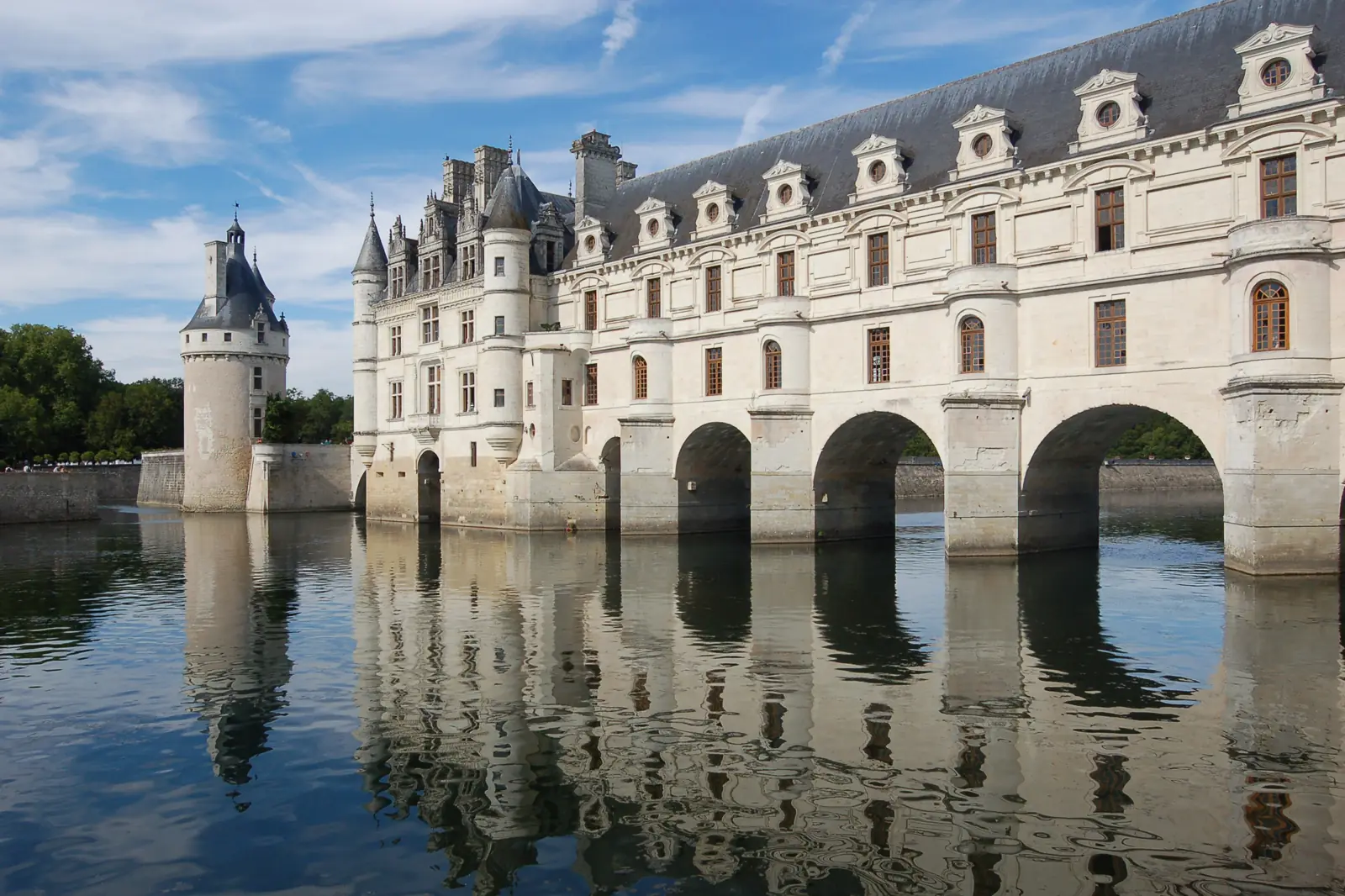
Chenonceau is the most romantic of the Loire châteaux. A beautiful château standing right on the river, it was given by King Henry II to his favourite, Diane de Poitiers. Fought over by Henry II's mistress and his wife Catherine de' Medici, the château has seen dozens of kings and queens. Later Rousseau worked here as a tutor and wrote his books, and Voltaire and other celebrities came to visit. The château's garden astonishes with its harmony and beauty. The château is preserved as though its crowned owners still lived there.
The Château de Blois rises above the town of Blois. In 1391 the county was bought by Louis, Duke of Orléans. His son Charles held poetry contests here, attended by François Villon. Louis XII, Charles's son, who inherited the French throne from Charles VIII, built a new royal residence here, open and spacious, consisting of three wings with galleries. Later the Château de Blois became the scene of the festivities, dramas and intrigues of the age of Henry II and Catherine de' Medici and of their three children, all kings of France. The Duke of Guise was murdered in one of the château's dark corridors. The château's architecture spans several eras, from the Middle Ages to the mid-17th century.
The Château d'Amboise is surrounded by a medieval town whose houses are carved directly into the rock, which is why its inhabitants are called troglodytes; the buildings are an unusual combination of stone and wood, and the chimneys are topped with fairy-tale beasts made of tin. The château itself is linked to the lives of Kings Charles VIII, Louis XII and Francis I, who succeeded in inviting the famous Leonardo da Vinci. The great master's tomb is here. After the brutal reprisals against the rebels of the "Amboise conspiracy of the Huguenots" in 1560, the château was almost uninhabited. Under Louis XIV it was used as a prison, where the famous Fouquet was held. The varied and whimsical ensemble of Amboise gives it a unique character that bears witness to its glorious and rich history.
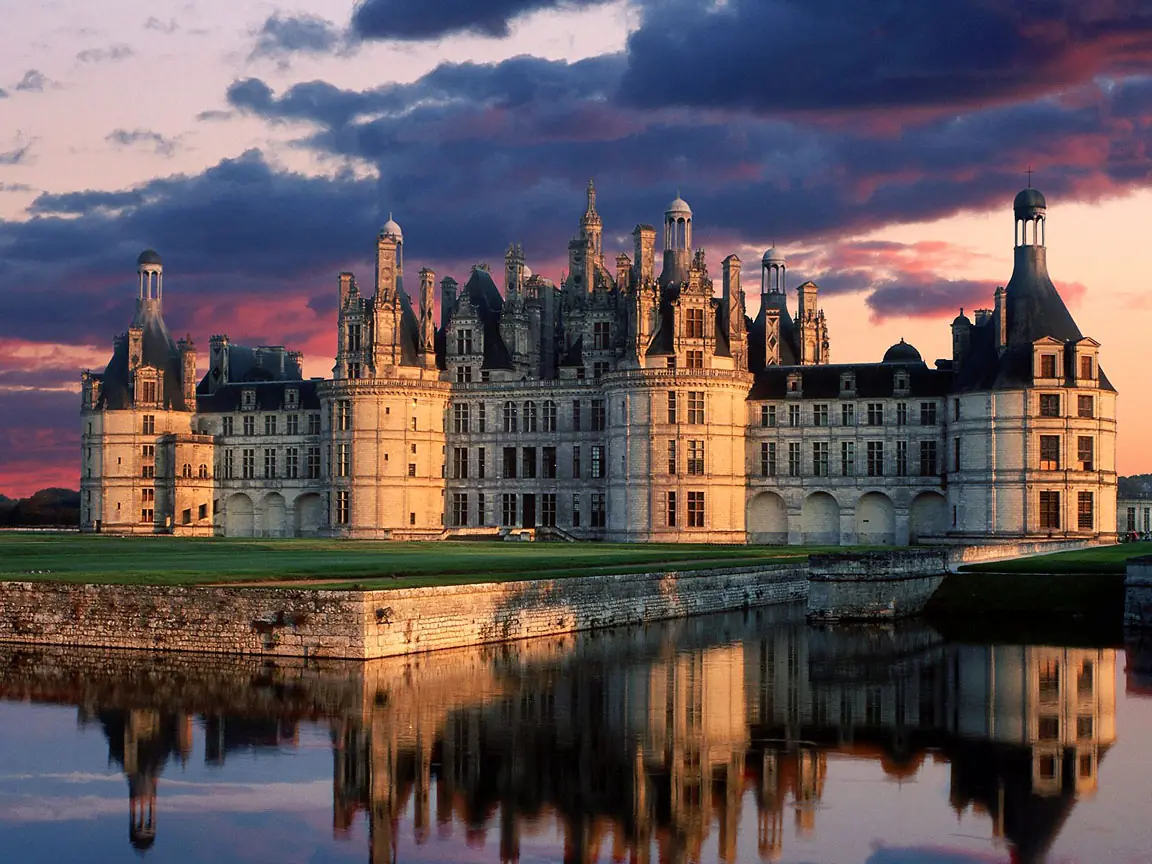
The hunting château of Chambord is a unique building, rightly considered one of the finest châteaux of the Renaissance. Its grandiose ensemble stands among forests where members of high society still hunt today. This splendour was conceived by King Francis I, who realised his dream of creating a romantic hunting château worthy of gods and legendary kings. Leonardo da Vinci himself took part in drawing up the plans. This largest château of the Loire Valley has 440 rooms, 365 chimneys, 83 staircases and a terrace of fairy-tale beauty. The château stands in a vast park enclosed by the longest wall in France. Molière wrote his plays here.
Duration of the excursion: 12-13 hours.
Guided tour of Reims and Épernay
The capital of the Champagne province, Reims (Reims), played a special role from the 12th century until 1825, as it was the traditional setting for the coronation of the kings of France. By custom the coronation was always preceded by the ceremony of anointing. The special Holy Ampulla is still kept in the Abbey of Saint-Remi (Saint-Remi). Notre-Dame Cathedral (Notre-Dame), the most striking monument of mature French Gothic, was built in Reims in the 13th century on the site of a burnt-down Carolingian church. It was in this cathedral that the kings of France ascended the throne. The facade of Notre-Dame is adorned with 2300 figures; especially well known is the statue of the Sly Saint, who winks at observant visitors. The stained-glass windows, damaged in both world wars, have gradually been restored. Since 1974 the choir has been adorned with windows made from designs by Marc Chagall. The Palais du Tau (Palais de Tau), the former residence of the archbishops of Reims, has become a museum where you can see tapestries of rare artistic quality and relics associated with the last coronation, that of Charles X in 1825. Reims has also preserved ruins from the Gallo-Roman era – the Porte de Mars and the cryptoporticus – and another marvel of early Gothic architecture, Saint-Remi.
Reims has three monuments of world importance protected by UNESCO: the Cathedral of Notre-Dame de Reims, the Palais du Tau and the basilica of the Abbey of Saint-Remi.
It was in Reims, on 7 May 1945, that the preliminary act of surrender of Nazi Germany was signed. Champagne attracts visitors not only with its historic monuments but also with its famous champagnes.
Épernay (Epernay), a small town 30 kilometres from Reims in the very heart of the vineyards, cannot really boast much of a historical heritage, apart perhaps from the magnificent Renaissance stained glass in the neo-Gothic church of Notre-Dame. But the cellars of this little town hold a veritable treasury of "liquid gold". Épernay is regarded as the capital of champagne, and beneath its streets lie 100 km of wine cellars where champagne went through every stage of fermentation before becoming world-famous. This is home to the world-renowned champagne "houses". One of them is Moët & Chandon (Moet & Chandon).
The history of the champagne house Moet & Chandon dates back to 1743. The company's prosperity owed much to the popularity of champagne at the court of the French kings. Moët & Chandon remains to this day an official supplier to the royal courts of Europe. Moët & Chandon's vineyards are the largest in Champagne, covering approximately 800 hectares – a quarter of the vineyards of the entire region. Moët & Chandon owns thirteen of the seventeen "grands crus".
Duration of the excursion to Reims and Épernay: about 8 hours.
Guided tour of Rouen
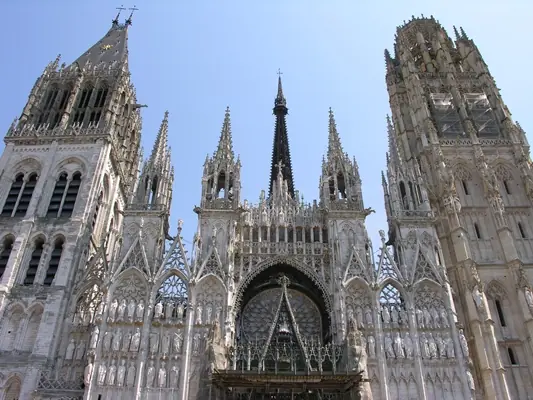
North-west of Paris, on the banks of the Seine, lies Rouen (Rouen), the capital of Upper Normandy. The city is a veritable museum of Gothic masterpieces. Rouen's great Cathedral of Notre-Dame is one of the most magnificent monuments of medieval architecture.
The Rue du Gros-Horloge was the first pedestrian zone in France. The tower with its giant clock face has become the city's most visited monument. The city gained sad notoriety from the trial of Joan of Arc, who was burned at the stake by the English in 1431 during the Hundred Years' War. Today, on the Place du Vieux-Marché, where Joan of Arc was executed, stands a church dedicated to her. Another of Rouen's treasures is the Church of Saint-Ouen, with its stained glass and fine 14th- and 16th-century wood carving.
This is where Gustave Flaubert was born and where he wrote his famous novel "Madame Bovary". The houses in the old part of the city look like dolls' houses: half-timbered facades, lacy balconies with geraniums, and attic windows.
Guided tour of Deauville, Trouville and Honfleur
The Flowered Coast (Côte Fleurie) is the name given to the Normandy coast from Trouville (Trouville) to Cabourg (Cabourg), already renowned in the 19th century as a fashionable seaside resort. The first resort on this coast was Trouville: while still a small fishing town, it caught the attention of Gustave Flaubert and Alexandre Dumas. By the mid-19th century the railway had arrived, the town began to grow, and fine hotels and elegant villas appeared along its beaches.
Deauville (Deauville), a small Normandy resort on the Atlantic coast that has kept the charm of the beginning of the last century, was founded in 1861 by the Duc de Morny (duc de Morny).
Its seafront promenades stand for elegance, prestige and refinement, which is why it attracts the French film crowd and wealthy people of all ages and nationalities. Calm and a measured pace of life reign here – villas and mansions surrounded by greenery, and hotels that look like palaces.
Nearby on the coast lies the old port town of Honfleur (Honfleur), one of the most picturesque harbours in France, which has attracted tourists and artists alike. You will recognise its harbour, with its white and blue yachts and fishing boats, from Impressionist paintings. It was from the shores of this town that the first expedition set out to discover America in the 16th century. Of particular interest is the wooden Church of St Catherine (Sainte-Catherine), built by shipwrights after the Hundred Years' War.
Programme: morning departure from Paris to Rouen, visit to the old town and the cathedral; drive to Honfleur via the Pont de Normandie; lunch in Honfleur; after lunch, a stroll through the old town and a visit to the Church of Sainte-Catherine; drive to Deauville, walking tour of the town and, in fine weather, a swim in the sea if you wish; return to Paris.
Guided tour of Étretat and Fécamp
From Rouen you can travel to the Normandy coast to the small town of Étretat (Etretat), whose coastal cliffs are breathtakingly beautiful. It was once a small fishing port that became famous for its unusual landscape and sheer white cliffs. Jutting out into the sea, they form mighty sea arches, and a little further on a 70-metre white stone obelisk rises straight out of the waves – the famous "Needle of Étretat", which once inspired Claude Monet to paint magnificent canvases. Thousands of tourists come here to relax: to stroll along the rocky coast, breathe the fresh sea air and enjoy the scenery and the fruits of the sea.
The town of Fécamp (Fecamp), 230 km from Paris on the Alabaster Coast, is known for its 13th-century Holy Trinity Church, which according to legend holds a few drops of the blood of Christ. It is kept in a vessel once fished out of the sea off the Normandy coast and apparently lost by crusaders on their way back from the Holy Land. The main place of pilgrimage, however, is the Palais Bénédictine, where in 1510 the monk Dom Bernardo Vincelli began making Bénédictine liqueur from 27 plants and spices. In the Palais Bénédictine you can visit a museum devoted to the making of the liqueur. Fécamp is also associated with Guy de Maupassant, who often came here to visit his grandmother, and several of his short stories are set in this very fishing port. Duration of the excursion: 12 hours.
Programme: morning departure from Paris to Rouen, visit to the old town and the cathedral; drive to Étretat; lunch at a seaside restaurant; visit to Étretat with a walk along the rocky coast and, in fine weather, a swim in the sea if you wish; visit to the town of Fécamp with its liqueur production and a tasting; return to Paris.
Guided tour of Mont-Saint-Michel Abbey
400 kilometres north-west of Paris, shrouded in mist and surrounded by water, stands a granite rock island that astonishes with its majesty and grandeur. The island, which rises to 78 metres, lies almost 2 kilometres from the shore, in the middle of a small bay. The tides here are among the most powerful in the world: the difference between low and high tide is about 9 metres. At high tide the island can only be reached by boat; at low tide the seabed is exposed and you can walk across to the island.
For several centuries two regions, Normandy and Brittany, fought over the right to call the island their own. As early as the 8th century a Benedictine monastery, more like a fortress, was built on the rock at the centre of the island. According to legend, the Archangel Michael appeared to the bishop of Avranches and commanded him to build a monastery, which later served both as a royal residence and as a centre of resistance in the Hundred Years' War.
Today Mont-Saint-Michel is a veritable living museum of the Middle Ages. The days when the abbey was a place of pilgrimage for monks who dreamed of spending the rest of their lives in a holy place are long gone, but its magical pull has not faded: millions of tourists come here from all over the world to see this wondrous island. From the shore, Mont-Saint-Michel looks like a mirage, a stage set for a fairy tale. But when the water recedes, you can walk freely into this fairy tale, stroll along the narrow streets of the little town and through the abbey, and wander through ancient halls filled with light from mysterious, unseen windows…
The French rightly call Mont-Saint-Michel the "eighth wonder of the world", and Europeans "the wonder of the Western world". Mont-Saint-Michel is inscribed by UNESCO on the list of World Natural and Cultural Heritage.
Duration of the excursion: 12-14 hours
Work out the price
Our rates for guided excursions across France. Choose an option and a car class — the price updates instantly.
Show the full price list
| Excursion | Duration | Standard (1-3 pax) | Standard (1-7 pax) | E-Class, Audi A4 (1-3 pax) | Viano (1-7 pax) | S-Class (1-3 pax) |
|---|---|---|---|---|---|---|
| Reims-Épernay | 10 h | 1015€ | 1125€ | 1125€ | 1440€ | 2005€ |
| Rouen-Honfleur-Deauville | 12 h | 1080€ | 1240€ | 1240€ | 1555€ | 2230€ |
| Loire Valley châteaux | 12 h | 1125€ | 1330€ | 1330€ | 1645€ | 2680€ |
Other services
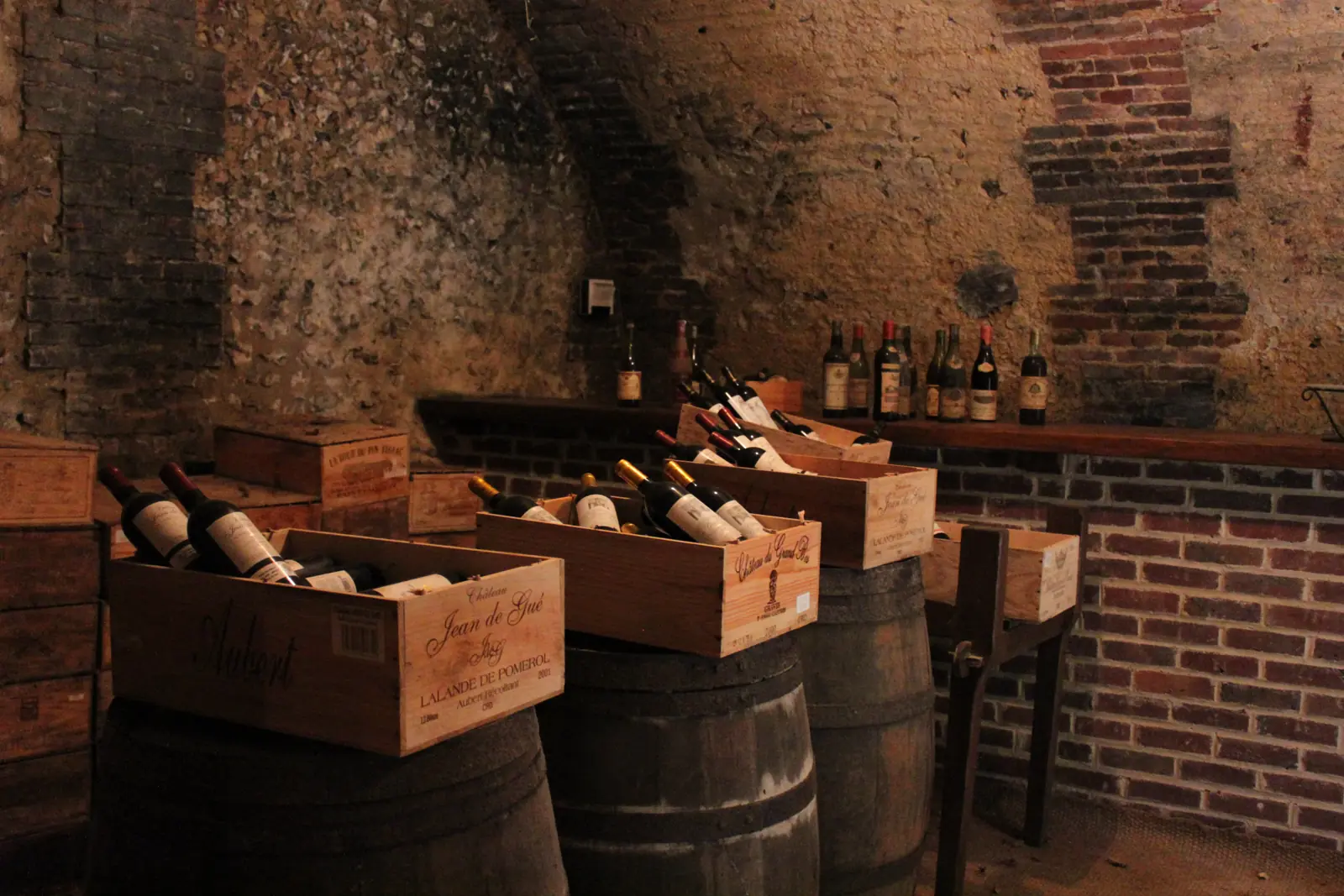 Dégustations
Tastings in France
Wine houses and estates, cider and calvados, cognac and liqueurs, cheese dairies and seafood farms — buying straight from the producer.
Learn more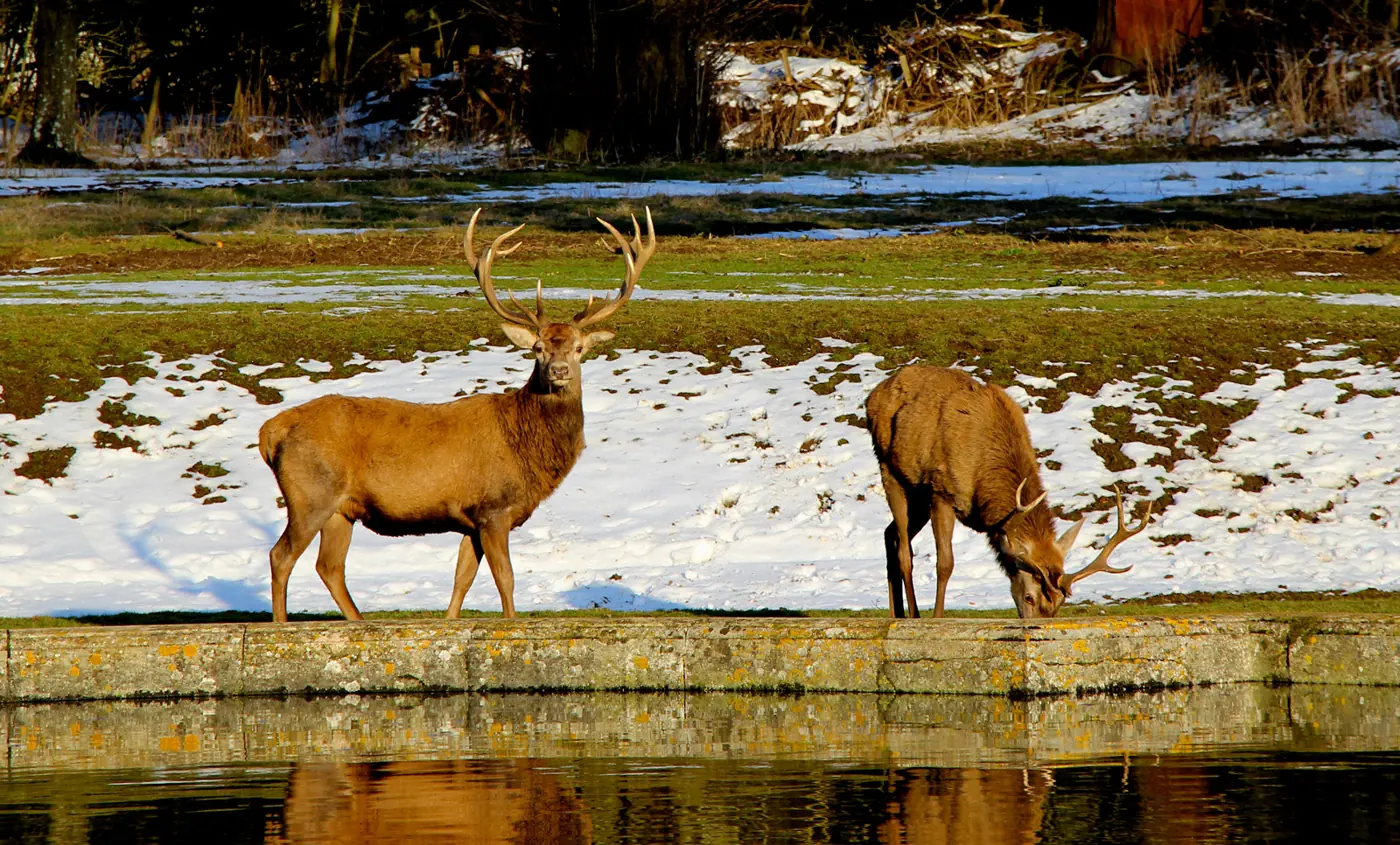 Chasse & pêche
Hunting in France
Private estates for seasoned hunters and beginners: wild boar, red and fallow deer, duck, pheasant and partridge. Fishing on the Rhine, in lakes and at sea.
Learn more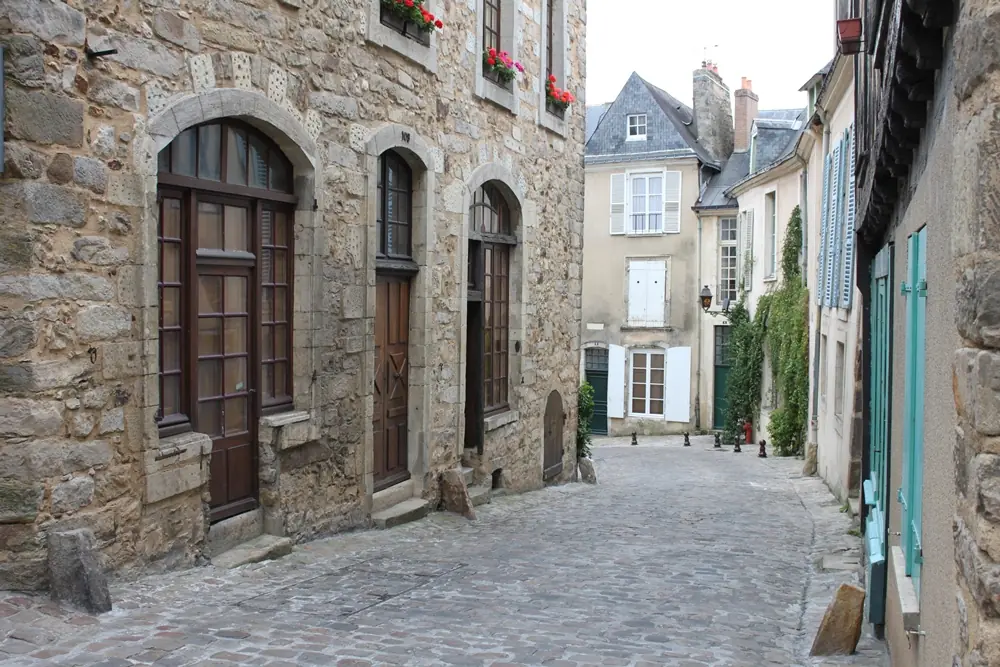 Shopping
Private shopping in Paris and French towns, with a stylist if you wish, and a car with driver for as long as you shop.
Learn more Conciergerie
Concierge services
Hotels, tables at restaurants, cabarets and clubs, tickets to concerts, exhibitions and fashion shows, flowers to your room — and anything else you ask for.
Learn moreTell us how you picture your trip
We reply within a working day with a programme and options for your budget. Paris transfers can be booked around the clock.